
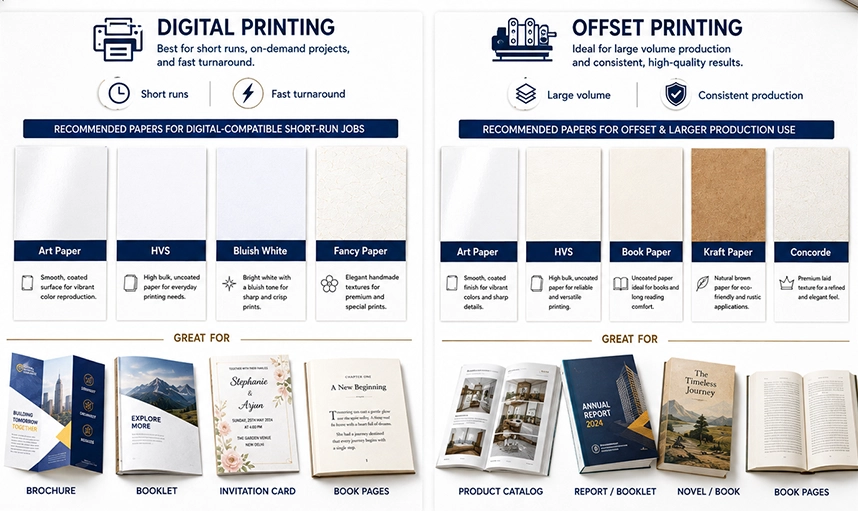
Printing Paper Guide : Art Paper, HVS, Concorde, Kraft & Book Paper
Choosing the right paper is one of the most important factors in determining the final quality of a printed product.
The same design can look very different when printed on glossy, matte, textured, naturally colored, or specialty book paper.
In addition to affecting color reproduction and image sharpness, the type of paper also influences :
- The visual character of the finished product.
- Thickness and weight.
- Color appearance.
- Ink absorption.
- Reading comfort.
- Ease of writing.
- Compatibility with finishing processes.
- Production cost.
- Compatibility with digital and offset printing equipment.
In this guide, we will discuss several paper types commonly used in the printing industry, including Art Paper, HVS, Concorde, Bluish White, Kraft Paper, Fancy Paper such as Jasmine, and Book Paper.
Please note that brand names, paper weights, colors, textures and printing compatibility can vary between manufacturers and suppliers. For jobs that require accurate color or special finishing, a physical sample and test print are always recommended.
Digital and Offset Printing Have Different Characteristics
Before selecting a paper, it is important to understand that Digital Printing and Offset Printing use different production processes.
Digital Printing
Digital Printing normally prints directly from a digital file without requiring printing plates.
It is particularly suitable for :
- Small to medium quantities.
- Personalized printing.
- Variable data printing.
- Fast production.
- Samples and prototypes.
- Short-run printing.
However, not every paper can be used on every digital printing machine. Paper thickness, coating, texture, moisture content and surface characteristics can affect how the machine feeds and prints the media.
Offset Printing
Offset Printing uses printing plates and an intermediate transfer system before the image reaches the paper.
It is commonly used for :
- Books.
- Magazines.
- Brochures.
- Flyers.
- Packaging.
- Catalogues.
- Large production quantities.
Offset Printing usually becomes more economical for larger print runs because the initial setup cost can be distributed across a greater quantity.
What Is Paper GSM?
Paper weight is commonly expressed in gsm, or grams per square metre.
Examples include :
- 70 gsm.
- 80 gsm.
- 100 gsm.
- 120 gsm.
- 150 gsm.
- 210 gsm.
- 260 gsm.
- 310 gsm.
Generally, a higher gsm means the paper feels heavier and often more rigid.
However, gsm is not exactly the same as thickness.
Two paper types with the same gsm can have different physical thicknesses because their fibers, coatings, density and manufacturing processes are different.
1. Art Paper
Art Paper is one of the most popular coated papers used in commercial printing.
Its surface is relatively smooth because it has a coating that helps ink or toner produce stronger color and fine image detail.
Art Paper is commonly used when the design requires :
- Photography.
- Strong colors.
- Image detail.
- A commercial appearance.
- A smooth surface.
Characteristics of Art Paper
Art Paper generally has the following characteristics :
- Smooth surface.
- Coated finish.
- Relatively clean white appearance.
- Suitable for full-color printing.
- Good image detail.
- Colors often appear more vivid than on many uncoated papers.
What Products Are Suitable for Art Paper?
Art Paper is commonly used for :
- Brochures.
- Flyers.
- Leaflets.
- Catalogues.
- Magazines.
- Posters.
- Company profiles.
- Menus.
- Calendars.
- Packaging inserts.
Art Paper for Digital Printing
Art Paper can be used on many digital printing systems, but the paper should be compatible with the specific machine technology.
Some digital presses have limits relating to thickness, coating and media construction.
Incompatible paper can cause :
- Poor toner adhesion.
- Surface scratching.
- Paper jams.
- Inconsistent color.
- Problems with duplex printing.
Always follow the media specifications recommended by the printing operator.
Art Paper for Offset Printing
Art Paper is widely used in Offset Printing because its coated surface helps reproduce detailed images and strong colors.
It is commonly selected for :
- Magazines.
- Catalogues.
- Large brochure runs.
- Company profiles.
- Promotional materials.
Advantages of Art Paper
- Relatively vivid color reproduction.
- Good photographic detail.
- Smooth surface.
- Excellent for full-color printing.
- Works well with lamination.
- Available in many paper weights.
Limitations of Art Paper
- Not ideal for writing with pencils or some pens.
- Handwritten ink may take longer to dry on coated surfaces.
- Does not provide the natural feel of uncoated paper.
- Surface reflection may reduce reading comfort under certain lighting.
2. What Is HVS Paper?
HVS is a commonly used uncoated paper for general printing and office applications.
Its surface does not have the glossy coating found on Art Paper, so it feels more natural and is easier to write on.
HVS is commonly used for :
- Documents.
- Letters.
- Invoices.
- Forms.
- Book interiors.
- Notepads.
- Manuals.
- Stationery.
Characteristics of HVS Paper
- Uncoated surface.
- Easy to write on with pens and pencils.
- More absorbent than Art Paper.
- Simple and functional appearance.
- Available in a variety of paper weights.
HVS for Digital Printing
HVS is one of the most common media used in digital printing.
It is suitable for :
- Color documents.
- Proposals.
- Manuals.
- Booklets.
- Forms.
- Stationery.
However, photographic reproduction on HVS normally looks different from Art Paper because HVS is more absorbent and uncoated.
HVS for Offset Printing
HVS is also widely used in Offset Printing, especially for products containing large amounts of text.
Typical applications include :
- Books.
- Forms.
- Receipts.
- Letterheads.
- Envelopes.
- Manuals.
Advantages of HVS
- Easy to write on.
- Good for text-heavy documents.
- Relatively economical.
- Widely available.
- Suitable for digital and offset printing.
- Comfortable for everyday documents.
Limitations of HVS
- Photography may not look as vivid as on coated paper.
- Ink can absorb more deeply into the fibers.
- Large dark areas may appear more matte.
- Does not provide the premium character of many specialty papers.
3. What Is Concorde Paper?
Concorde paper is a premium specialty printing paper known for its signature embossed, fine-lined texture. It is widely used for formal documents, certificates, business cards, and invitations to give a luxurious, professional feel. It usually has a distinctive surface character or texture that makes it visually different from HVS and Art Paper.
Characteristics :
- Texture : Distinct fine lines or a subtle mesh pattern giving a tactile, cloth-like feel.
- Weights : Available in various thicknesses, typically ranging from light (90 gsm) to heavy cardstock (160 gsm and 220/230 gsm).
- Colors : Comes in classic white/cream as well as soft pastel shades (light blue, green, pink, yellow)
Products Suitable for Concorde
Concorde is often used for :
- Certificates.
- Invitations.
- Business cards.
- Corporate stationery.
- Covers.
- Greeting cards.
- Premium menus.
- Formal invitations.
Advantages of Concorde
- Premium surface character.
- Works well with minimalist designs.
- Creates a formal appearance.
- Suitable for typography and logos.
- Attractive for corporate products.
Things to Consider with Concorde
Because its surface texture can vary between products, print results may differ from coated paper.
On some Concorde stocks, large areas of solid color can allow the paper texture to remain visible.
This is not necessarily a defect. In many cases, the texture is part of the intended aesthetic.
For artwork containing large solid areas or very fine detail, a test print is recommended.
4. What Is Bluish White Paper?
Bluish White is generally used to describe white paper with a slightly cooler or bluish tone compared with natural white paper.
The base color of the paper is important because it affects how printed colors are perceived.
Bluish White paper often creates a visual impression that is :
- Clean.
- Bright.
- Modern.
- Formal.
Uses of Bluish White Paper
Bluish White can be used for products such as :
- Stationery.
- Certificates.
- Invitations.
- Company profiles.
- Business cards.
- Premium documents.
- Covers.
Its exact characteristics depend on the brand and paper series being used.
Paper Color Affects Printed Color
Most standard CMYK printing processes do not print white ink.
White areas in the artwork are normally created by leaving the paper unprinted.
This means bluish white, warm white, ivory, cream and brown Kraft papers can all affect the final appearance of printed colors even when the same CMYK file is used.
5. What Is Kraft Paper?
Kraft Paper is a paper with a natural appearance, commonly associated with a brown base color.
Kraft is popular for designs that aim to communicate :
- Natural character.
- Rustic style.
- Handmade quality.
- Organic character.
- Eco-inspired branding.
- Craft aesthetics.
Products Suitable for Kraft Paper
Kraft is commonly used for :
- Paper bags.
- Packaging.
- Hang tags.
- Business cards.
- Invitations.
- Certain food packaging.
- Product labels.
- Envelopes.
- Wrapping.
Challenges of Printing on Kraft Paper
Because Kraft is not white, its brown base color affects the printed result.
For example :
- Yellow may appear darker.
- Pastel colors may lose brightness.
- Photography can look warmer or more muted.
- White areas in the file will not automatically print white.
If white printing is required on Kraft, a printing process that supports White Ink or White Toner is needed.
Kraft Paper for Minimalist Design
Kraft works particularly well with simple artwork using :
- Black ink.
- Dark typography.
- Simple logos.
- Line art.
- White ink when supported.
- Hot Foil.
Black or white printing on Kraft can create a strong and natural visual identity.
6. What Is Fancy Paper (jasmine) ?
Fancy Paper is a broad term for specialty papers that have unusual colors, textures, surface effects or finishes compared with standard paper.
Fancy Paper may have characteristics such as :
- Textured surfaces.
- Metallic effects.
- Pearlescent finishes.
- Embossed textures.
- Natural fibers.
- Colored stocks.
- Shimmer effects.
Jasmine is a name commonly associated with decorative fancy paper that often has a shimmer or pearlescent surface.
This makes Jasmine popular for products that need an :
- Elegant appearance.
- Luxury feel.
- Wedding aesthetic.
- Premium presentation.
- Decorative character.
Products Suitable for Jasmine Paper
- Wedding invitations.
- Greeting cards.
- Premium business cards.
- Certificates.
- Menus.
- Product tags.
- Luxury packaging accents.
- Invitation envelopes.
Consider the Surface Effect of Jasmine Paper
Because Jasmine has a distinctive decorative surface, its shimmer can affect the way printed colors appear under different lighting angles.
Simple designs using typography, logos or ornaments often work better than designs that cover the entire surface with photography.
Fancy Paper Can Work Well with Premium Finishing
Some Fancy Papers can produce excellent results when combined with :
- Gold Hot Foil.
- Silver Hot Foil.
- Rose Gold Foil.
- Embossing.
- Debossing.
- Die Cutting.
- Certain Laser Cutting processes.
However, finishing compatibility should always be tested because coatings, textures and material construction vary between Fancy Paper products.
7. What Is Book Paper?
Book Paper is a type of paper designed or commonly selected for book interiors.
It is typically chosen because it provides better reading comfort over long periods.
Unlike Art Paper, which has a coated surface and can reflect more light, Book Paper usually has :
- A matte appearance.
- An uncoated or low-gloss surface.
- Relatively low weight.
- Good reading comfort.
- Low light reflection.
Book Paper Is Often Not Bright White
Many Book Papers have a more natural, ivory or cream tone.
This can reduce the strong contrast between black text and bright white paper.
As a result, some readers may find it more comfortable for long reading sessions.
Products Suitable for Book Paper
Book Paper is particularly suitable for :
- Novels.
- General reading books.
- Literature.
- Religious books.
- Educational books.
- Text-heavy manuals.
- Publications with high page counts.
Advantages of Book Paper
- Comfortable for reading.
- Relatively lightweight.
- Helps reduce the overall weight of thick books.
- Low surface glare.
- Good for black text.
- Provides a classic or natural appearance.
Limitations of Book Paper
- Not designed to reproduce photography as vividly as Art Paper.
- Colors may appear more muted.
- Heavy ink coverage may look different on an uncoated surface.
- Not always suitable for photo-heavy catalogues.
Book Paper for High Page Counts
One major advantage of Book Paper is its relationship between volume and weight.
For a book with hundreds of pages, choosing paper that is too heavy can make the finished book :
- Very thick.
- Heavy.
- More expensive to ship.
- Less comfortable to hold and read.
This is one reason Book Paper is commonly selected for publications with many pages.
Art Paper vs HVS vs Book Paper
| Paper Type | Surface | Main Strength | Best For |
|---|---|---|---|
| Art Paper | Smooth and coated | Photography and vivid color | Brochures, catalogues, posters |
| HVS | Uncoated | Text and writing | Documents, forms, books |
| Book Paper | Matte / uncoated | Reading comfort | Novels and text-heavy books |
Concorde vs Jasmine
| Paper Type | Character | Visual Impression | Common Use |
|---|---|---|---|
| Concorde | Specialty / textured | Formal and professional | Certificates, cards, stationery |
| Jasmine | Fancy / shimmer | Elegant and decorative | Invitations and premium cards |
White Paper vs Kraft Paper
Artwork printed on white paper can generally reproduce colors closer to standard CMYK expectations.
On Kraft, the brown base color becomes part of the final appearance.
For this reason, artwork for Kraft should ideally be designed specifically for that material rather than simply reusing a design created for white paper.
Coated vs Uncoated Paper
Paper can broadly be divided into coated and uncoated categories.
Coated Paper
Coated paper has a surface layer designed to control ink absorption.
Examples include :
- Art Paper.
- Certain coated specialty papers.
The main advantage is that images and colors often appear stronger and more detailed.
Uncoated Paper
Uncoated paper does not have the same type of surface coating.
Examples include :
- HVS.
- Book Paper.
- Kraft Paper.
- Many types of Fancy Paper.
Uncoated paper generally has a more natural appearance and absorbs more ink.
Paper Type Affects CMYK Color
The same CMYK value can look different on different paper stocks.
For example :
C100 M70 Y0 K0
may appear differently when printed on :
- Glossy Art Paper.
- HVS.
- Cream Book Paper.
- Brown Kraft Paper.
- Pearlescent Fancy Paper.
This happens because every paper has different surface texture, base color, coating and ink absorption characteristics.
Photography Is Better Suited to Certain Papers
If the design is dominated by photography and requires strong color detail, Art Paper or another coated medium is often more suitable.
If the product is primarily text-based and intended for long reading sessions, HVS or Book Paper may provide greater comfort.
Not Every Paper Is Ideal for Heavy Solid Black
Large black areas or heavy solid colors can behave differently on different surfaces.
On coated paper, the color usually appears more solid.
On textured or uncoated paper, the character of the paper surface may remain visible.
This is particularly important with :
- Concorde.
- Kraft.
- Jasmine.
- Other Fancy Papers.
Consider Duplex Printing
When printing on both sides, paper opacity becomes important.
Paper that is too thin may allow printing from the opposite side to remain visible through the sheet.
This effect is known as :
Show-through.
For books and double-sided documents, choose a paper weight and opacity appropriate for the amount of ink coverage.
Consider Finishing After Printing
Paper type also affects which finishing processes can be used successfully.
Examples include :
- Lamination.
- Hot Foil.
- Embossing.
- Debossing.
- Spot UV.
- Die Cutting.
- Creasing.
- Folding.
Not every finishing process performs the same way on every paper type.
Heavy Paper May Require Creasing Before Folding
High-gsm paper can crack or split along the fold if folded directly.
For thick covers, invitations or cards, a creasing process is often performed before folding.
Creasing creates a controlled fold line and helps produce a cleaner result.
Consider Paper Grain Direction
The paper grain direction affects the way paper folds, opens and behaves during binding.
Using the correct grain direction can help :
- Reduce cracking.
- Create cleaner folds.
- Improve binding quality.
- Make pages easier to open.
GSM Is Not the Only Factor
When selecting paper, do not consider only the gsm number.
Also evaluate :
- Thickness.
- Opacity.
- Surface texture.
- Paper color.
- Coating.
- Stiffness.
- Grain direction.
- Printing compatibility.
- Finishing compatibility.
Recommended Paper by Product Type
| Product | Common Paper Type | Main Characteristic |
|---|---|---|
| Brochure / Flyer | Art Paper | Strong photography and color |
| Document / Form | HVS | Easy to write on |
| Certificate | Concorde / Bluish White / Fancy Paper | Formal and premium |
| Invitation | Concorde / Jasmine / Fancy Paper | Elegant and decorative |
| Natural Packaging | Kraft Paper | Natural and rustic |
| Novel | Book Paper | Reading comfort |
| Catalogue | Art Paper | Photography and color |
| Premium Business Card | Concorde / Jasmine / Fancy Paper | Texture and premium feel |
Recommendations Based on Design Character
If your design requires :
- Vivid photography → consider Art Paper.
- Large amounts of text and easy writing → consider HVS.
- A formal textured appearance → consider Concorde.
- A bright, clean white appearance → consider a suitable Bluish White paper.
- A natural or rustic style → consider Kraft Paper.
- Shimmer and premium effects → consider Jasmine or another Fancy Paper.
- A book with many pages → consider Book Paper.
Do Not Choose Paper Only from Online Photos
Paper color and texture are difficult to judge accurately on a monitor.
This is especially true for :
- Kraft.
- Concorde.
- Jasmine.
- Fancy Paper.
- Cream Book Paper.
Whenever possible, inspect a physical sample or paper swatch before making the final decision.
Test Print Important Brand Colors
If a project contains important brand colors, create a test print using the actual paper that will be used for production.
Do not proof the design on Art Paper and assume the colors will look the same on Kraft or Book Paper.
The substrate itself is part of the final color result.
Digital and Offset Printing Can Look Different on the Same Paper
The same paper may not produce identical results when printed using Digital and Offset Printing.
Differences may be influenced by :
- Toner or ink technology.
- Color profiles.
- Machine pressure.
- Fuser temperature on certain digital systems.
- Ink absorption.
- Screening.
- Calibration.
For repeat orders where color consistency is important, use the same printing process and paper whenever possible.
Paper Selection Checklist
- Determine whether the job will use Digital or Offset Printing.
- Confirm the finished product size.
- Confirm the page count.
- Determine whether printing is single-sided or double-sided.
- Check the paper gsm.
- Check the actual thickness.
- Check opacity.
- Check the paper's base color.
- Check texture.
- Determine whether the paper is coated or uncoated.
- Confirm compatibility with the printing machine.
- Check folding and creasing requirements.
- Check the binding method.
- Check finishing such as lamination, foil or embossing.
- Use a physical sample whenever possible.
- Create a test print for color-critical work.
Summary of Common Paper Types
| Paper Type | Main Characteristic | Best For | Important Note |
|---|---|---|---|
| Art Paper | Smooth, coated, vivid colors | Brochures, catalogues, posters | Excellent for photography |
| HVS | Uncoated and easy to write on | Documents, books, forms | Practical and economical |
| Concorde | Specialty / textured | Certificates, invitations, cards | Formal and premium appearance |
| Bluish White | Cooler white tone | Stationery, certificates, cards | Characteristics vary by brand and series |
| Kraft Paper | Brown and natural | Packaging, tags, invitations | Paper color affects printed color |
| Jasmine / Fancy Paper | Decorative, shimmer or textured | Invitations, premium cards | Ideal for premium designs |
| Book Paper | Matte, lightweight, comfortable to read | Novels and reading books | Ideal for high page counts |
Conclusion
There is no single paper type that is best for every printing project.
Art Paper is highly suitable for projects that require photography, image detail and strong color reproduction.
HVS is a practical choice for documents, forms, manuals and products that need to be easy to write on.
Concorde provides a more formal and textured character, making it suitable for certificates, invitations, stationery and premium printed products.
Bluish White has a cooler, cleaner white tone that can provide a modern and formal appearance for selected products.
Kraft Paper has a brown natural base color and is ideal for packaging, tags, invitations and branding with rustic, handmade or organic characteristics.
Fancy Paper such as Jasmine offers decorative and premium visual effects through texture, shimmer or pearlescent finishes, making it popular for invitations and luxury print products.
Book Paper is designed around reading comfort and overall book weight, making it particularly suitable for novels, reading books and publications with many pages.
Paper selection should not be based only on gsm or price. Also consider the paper base color, texture, coating, opacity, physical thickness, grain direction, printing process, binding method and finishing requirements.
Most importantly, do not judge a paper only from a photo or monitor preview. For professional printing, inspect physical samples and perform test prints whenever color, texture or finishing is important to the final result.