
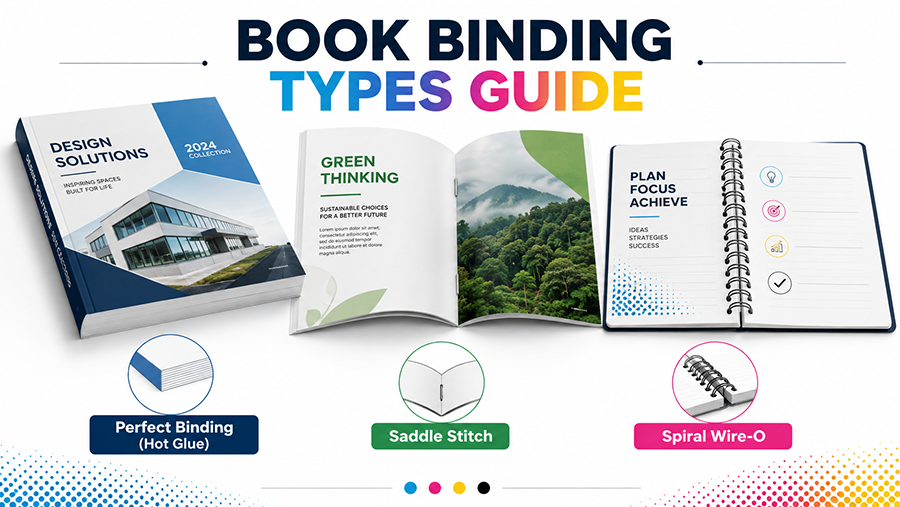
Printing Binding Types : Perfect Binding, Saddle Stitch, Wire-O
In the production of books, booklets, catalogues, company profiles, menus, manuals, notebooks and many other printed products, the binding method plays an important role in both appearance and functionality.
Binding is not simply a way to hold pages together. The selected binding method can affect :
- The final appearance of the product.
- Strength and durability.
- How easily pages can be opened.
- The number of pages that can be bound.
- The type and thickness of paper that can be used.
- Production cost.
- Production speed.
- Whether the finished product looks economical, professional or premium.
A binding method that works well for a thick catalogue may not be suitable for a notebook. Likewise, a binding method designed for a 200-page book may be unnecessary for a 12-page booklet.
In this guide, we will explain several of the most common binding methods used in the printing industry, especially Perfect Binding or Hot Glue Binding, Stapled or Saddle Stitch Binding, and Spiral Wire-O Binding.
1. What Is Book Binding?
Binding is the process of joining printed pages or sheets together to create a finished book, booklet or document.
Different binding systems may use :
- Adhesive.
- Staples.
- Metal wire.
- Plastic combs.
- Thread.
- Rings.
- Hardcover cases.
The correct method should be selected according to the number of pages, book thickness, paper type, intended use and production budget.
2. What Is Perfect Binding?
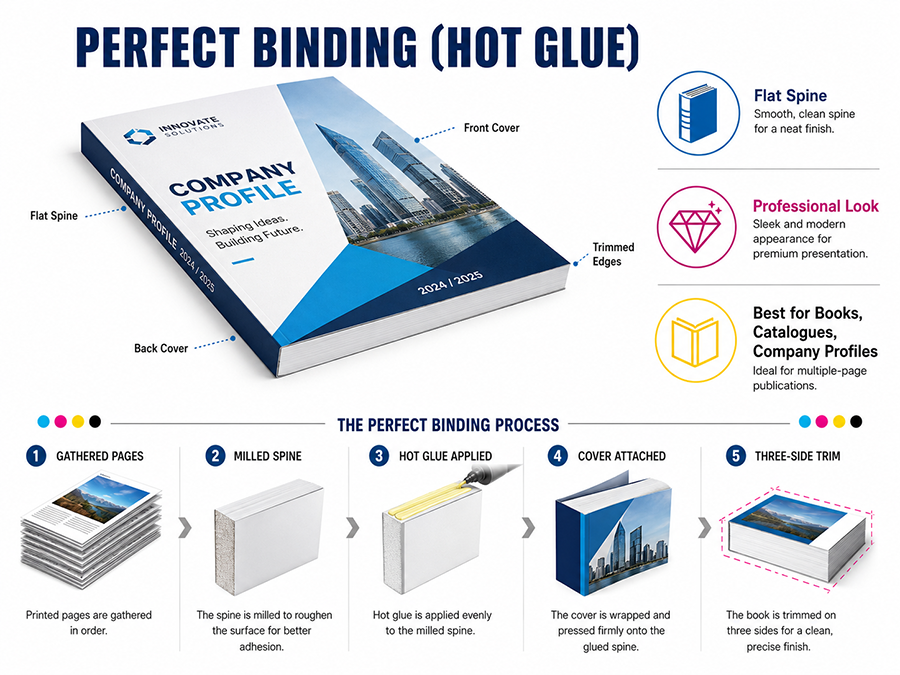
Perfect Binding is a binding method in which the pages are attached to the cover using adhesive along the spine.
It is also commonly referred to as :
Hot Glue Binding or Hot Melt Binding.
Perfect Binding is widely used because it creates a clean, flat spine and gives the finished book a professional appearance similar to many commercially produced paperback books.
3. How Does Perfect Binding Work?
During the Perfect Binding process, the pages are gathered in the correct sequence and the spine area is prepared so that the adhesive can bond effectively.
A typical production process includes :
- Gathering pages in the correct order.
- Aligning the book block.
- Roughening or milling the spine edge.
- Applying hot adhesive to the spine.
- Attaching the cover around the book block.
- Allowing the adhesive to cool or cure.
- Trimming the remaining three sides for a clean finish.
4. Products Suitable for Perfect Binding
Perfect Binding is commonly used for :
- Books.
- Novels.
- Company profiles.
- Annual reports.
- Product catalogues.
- Thicker magazines.
- Manuals.
- Prospectuses.
- Portfolios.
- Guide books.
5. Advantages of Perfect Binding
- Creates a professional appearance.
- Provides a flat, printable spine.
- The title can be printed on the spine when it is thick enough.
- Suitable for medium to high page counts.
- Usually more economical than hardcover binding.
- Works well with full-color printed covers.
- Suitable for commercial book production.
6. Limitations of Perfect Binding
- The book does not normally open completely flat.
- Content near the spine may become difficult to see.
- Not ideal for extremely low page counts.
- Durability depends on the adhesive, paper and production quality.
- Pages may loosen if the bonding process is not performed correctly.
7. What Is Hot Glue?
Hot glue, or hot-melt adhesive, is applied while heated and becomes solid as it cools.
In book binding, the adhesive is applied to the prepared spine of the page block before the cover is attached.
The exact adhesive formulation can vary depending on the binding machine, paper type and production requirements.
8. PUR Binding as an Alternative
Some premium Perfect Binding workflows use PUR, or Polyurethane Reactive adhesive.
PUR adhesive is known for providing strong and flexible bonding on a wide variety of paper stocks.
It may be selected for books that require greater durability or flexibility than standard hot-melt adhesive can provide.
Availability depends on the equipment and capabilities of the printing company.
9. Pay Attention to the Area Near the Spine
Because most Perfect Bound books do not open fully flat, content positioned too close to the spine may become difficult to read or view.
This is particularly important for :
- Body text.
- Page numbers.
- Photographs.
- Diagrams.
- Tables.
Use a sufficient inside margin, also known as the gutter, so that important content does not disappear too deeply into the binding.
10. Avoid Important Content Across the Center of a Spread
If a photograph or graphic extends across two facing pages, the center of the image may disappear partially into the binding.
This is particularly noticeable with Perfect Binding.
Avoid positioning important elements such as :
- Faces.
- Logos.
- Important letters.
- Numbers.
- Main subjects.
directly across the center of the spread when they must remain fully visible.
11. What Is Stapled Binding?
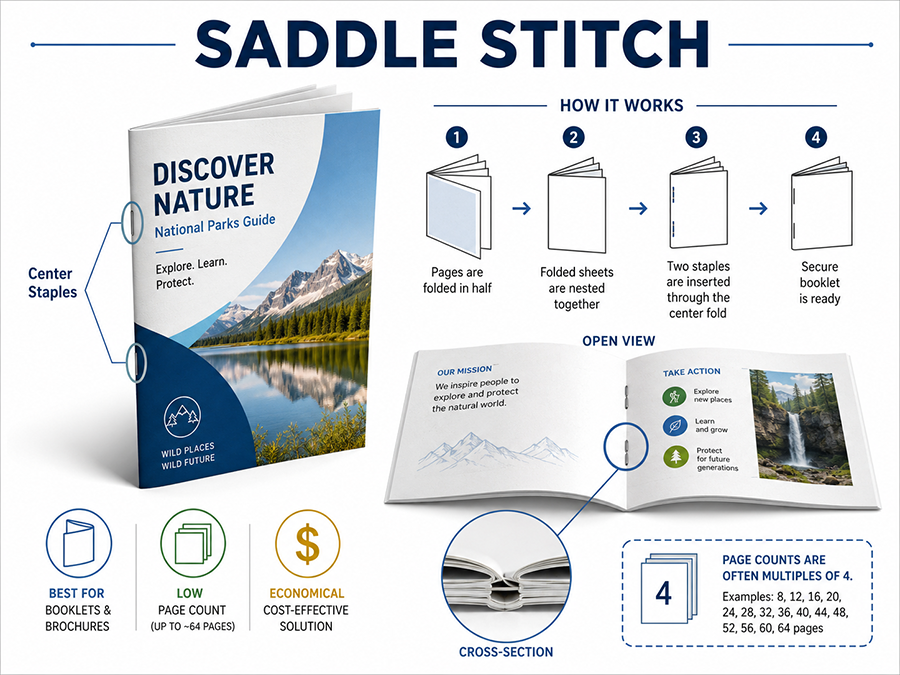
Stapled Binding uses metal staples to hold pages together.
For booklets, the most common version is known as :
Saddle Stitch Binding.
In this method, printed sheets are folded in half and staples are inserted through the center fold.
12. Saddle Stitch vs Side Stapling
Although both methods use staples, they are different.
| Method | Staple Position | Typical Use |
|---|---|---|
| Saddle Stitch | Through the center fold | Booklets, brochures and thin magazines |
| Side Staple | Along one side near the spine | Simple documents or loose-sheet sets |
13. How Is Saddle Stitch Produced?
A typical Saddle Stitch production process includes :
- Pages are arranged through imposition.
- Sheets are printed on both sides.
- The sheets are folded in half.
- The folded sheets are nested together.
- Staples are inserted through the center fold.
- The finished booklet is trimmed for clean edges.
14. Products Suitable for Saddle Stitch
- Booklets.
- Multi-page brochures.
- Thin company profiles.
- Menus.
- Event programs.
- Instruction booklets.
- Thin magazines.
- Small catalogues.
- Simple product manuals.
15. Advantages of Saddle Stitch
- Economical.
- Fast production.
- Simple and clean appearance.
- Suitable for low page counts.
- Can open relatively wide.
- Does not require adhesive.
- Usually lightweight.
16. Limitations of Saddle Stitch
- Not suitable for very thick books.
- Does not create a flat printable spine.
- Page counts normally need to follow a folded-sheet structure.
- Thicker booklets can experience page creep.
17. Why Are Saddle Stitch Page Counts Usually Multiples of Four?
A single sheet folded in half creates four pages.
Therefore, Saddle Stitch booklets commonly use page counts such as :
8, 12, 16, 20, 24, 28, 32 pages and so on.
This is because each folded sheet contributes four individual pages to the finished booklet.
18. What Is Page Creep?
In thicker Saddle Stitch booklets, the inner folded sheets extend slightly farther outward than the outer sheets.
This effect is called page creep.
When the booklet is trimmed, the internal page margins may therefore appear slightly different from the outer pages.
Professional imposition software can compensate for creep during production.
19. Keep Important Elements Away from the Edge
Because folding, nesting and trimming all introduce production tolerances, important elements should remain safely inside the trim area.
Always consider :
- Bleed.
- Safe areas.
- Adequate margins.
This is particularly important for small text, page numbers, borders and symmetrical designs.
20. What Is Wire-O Binding?
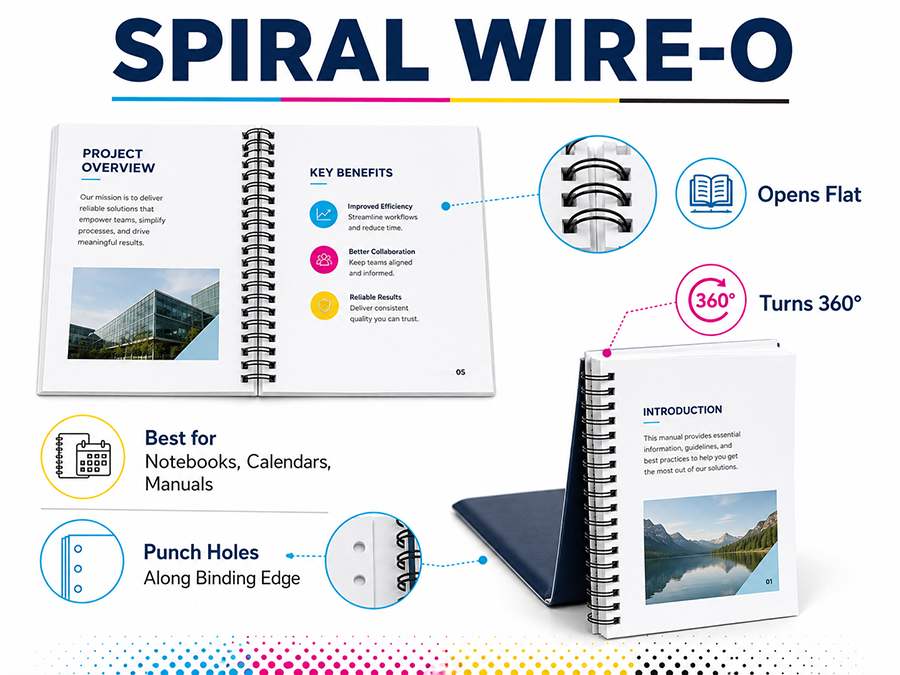
Wire-O Binding uses a metal double-loop wire inserted through a series of punched holes along one edge of the pages.
It is also commonly referred to as :
- Wire Binding.
- Wire-O.
- Double-Loop Wire Binding.
- Spiral Wire, although Wire-O and true spiral coil systems are technically different.
21. Wire-O and Spiral Coil Are Not the Same
The word “spiral” is often used casually for both systems, but technically they are different.
| Binding Type | Construction | Character |
|---|---|---|
| Wire-O | Double-loop metal wire | Clean and professional |
| Spiral Coil | Continuous spiral coil | Flexible and durable for repeated use |
22. How Is Wire-O Binding Produced?
A typical Wire-O process includes :
- Printing and trimming the pages.
- Punching holes along the binding edge.
- Inserting the wire through the punched holes.
- Closing the wire using a binding machine.
Unlike Perfect Binding, Wire-O does not rely on adhesive along the spine.
23. Products Suitable for Wire-O Binding
- Notebooks.
- Calendars.
- Desk calendars.
- Training manuals.
- Presentation books.
- Catalogues.
- Menus.
- Portfolios.
- Instruction manuals.
- Workbooks.
- Sketchbooks.
24. Advantages of Wire-O Binding
- Pages can open almost 360 degrees.
- The book can lie flat when open.
- Comfortable for writing.
- Excellent for notebooks and manuals.
- Professional appearance.
- Available for a range of book thicknesses.
- Wire is available in different sizes and colors.
25. Limitations of Wire-O Binding
- Usually more expensive than stapling.
- Punched holes reduce the usable design area near the binding edge.
- Metal wire can deform if subjected to strong pressure.
- Requires dedicated punching and binding equipment.
26. Allow Extra Margin for Wire-O Punching
A common design mistake with Wire-O products is placing text or logos too close to the binding edge.
This area will be punched during production.
Make sure :
- Text does not enter the punching area.
- Logos have sufficient clearance.
- Page numbers are not too close to the binding.
- Important elements have additional margin.
Ask the printer about the punch size and Wire-O pitch because these can vary between binding systems.
27. Why Is Wire-O Good for Notebooks?
One of the biggest advantages of Wire-O is that pages can lie flat or fold almost completely behind the book.
This makes the product comfortable for :
- Writing.
- Drawing.
- Reading manuals.
- Following training materials.
- Completing workbooks.
28. Perfect Binding vs Saddle Stitch vs Wire-O
| Binding Type | Main Characteristic | Best For |
|---|---|---|
| Perfect Binding / Hot Glue | Flat adhesive spine | Books, catalogues and company profiles |
| Saddle Stitch / Stapled | Staples through the center fold | Thin booklets and brochures |
| Wire-O | Double-loop metal wire | Notebooks, calendars and manuals |
29. Choose Perfect Binding If...
- The book has a medium or high page count.
- You want a retail paperback appearance.
- You need a printable spine.
- The product should look formal and professional.
- You want a more economical option than hardcover.
30. Choose Saddle Stitch If...
- The page count is relatively low.
- You need an economical production method.
- The product is a booklet or brochure.
- A printable spine is not necessary.
- Fast production is important.
31. Choose Wire-O If...
- The product needs to open flat.
- The user will frequently write in it.
- Pages will be turned repeatedly.
- The product is a notebook or calendar.
- The visible binding is part of the design style.
32. What Is Comb Binding?
Comb Binding uses a plastic comb with multiple rings that pass through punched holes along one side of the document.
It is commonly used for :
- Reports.
- Training materials.
- Proposals.
- Manuals.
- Office documents.
One advantage of Comb Binding is that pages can often be added or removed by reopening the comb with the appropriate equipment.
33. What Is Spiral Coil Binding?
Spiral Coil Binding uses one continuous coil that passes through holes along the binding edge.
Depending on the system, the coil may be made from plastic or another flexible material.
It is commonly used for :
- Notebooks.
- Workbooks.
- Manuals.
- School materials.
- Certain calendars.
34. What Is Hardcover or Case Binding?
Case Binding is the traditional method used to create hardcover books.
The internal pages are assembled into a book block and then attached to a rigid cover made from board and a printed or decorative covering material.
Hardcover binding is commonly used for :
- Premium books.
- Photo books.
- Premium annual reports.
- Wedding albums.
- Corporate books.
- Coffee-table books.
- Limited-edition books.
35. Advantages of Hardcover Binding
- Very durable.
- Creates a premium appearance.
- Provides strong protection for the pages.
- Suitable for products intended to last many years.
- Can be combined with Hot Foil, Embossing, Debossing or Spot UV.
36. Limitations of Hardcover Binding
- Higher production cost.
- More complex manufacturing process.
- Heavier finished product.
- Usually requires a longer production process.
37. The Cover and Internal Pages Can Use Different Paper
For many binding methods, the cover is produced using thicker material than the internal pages.
For example :
- Internal pages : 100–150 gsm.
- Cover : 210–350 gsm.
These values are only general examples. The correct paper weight should be selected according to the product and binding system.
38. Cover Lamination Can Improve Durability
Perfect Bound, Saddle Stitched and Wire-O covers can often be enhanced with finishing such as :
- Matte lamination.
- Gloss lamination.
- Soft-touch lamination.
- Spot UV.
- Hot Foil.
- Embossing.
These finishes can improve appearance while also protecting the cover surface.
39. Consider Paper Grain Direction
In professional book production, paper grain direction can affect how pages fold, open and behave around the spine.
Using the appropriate grain direction can help improve folding quality and the way the book opens.
This is especially important when using heavier papers or certain finishing processes.
40. Book Thickness Helps Determine the Binding Method
Not every binding method is suitable for every page count.
As a general guide :
- Very low page count → Saddle Stitch.
- Medium to high page count → Perfect Binding.
- Must open flat → Wire-O or Spiral Coil.
- Premium long-lasting product → Hardcover.
However, the final decision should also consider paper thickness and overall construction.
41. How Is the Spine Width Calculated for Perfect Binding?
The spine width is determined by the total thickness of all internal pages.
Do not calculate the spine width only by estimating the number of pages.
Different paper stocks and paper weights have different physical thicknesses.
Ask the printing company for the final spine measurement before completing the cover artwork.
42. Do Not Finalize the Perfect Bound Cover Before Confirming the Spine
A Perfect Bound cover generally consists of :
Back Cover + Spine + Front Cover
If the spine width is incorrect, the front and back artwork can shift out of position.
Sensitive elements such as spine text, vertical lines or frames should only be finalized after the actual spine measurement is confirmed.
43. Spine Text Requires a Safe Area
Text on the spine should not be positioned too close to the fold lines.
Small production variations during binding and trimming may make text appear off-center when the spine is narrow.
If the spine is extremely thin, it may be better not to include spine text at all.
44. Consider Double-Sided Printing Tolerances
Books and booklets are normally printed on both sides of the paper.
Front-to-back registration is subject to normal production tolerance.
Avoid designs that depend on perfectly matching elements from one side of the sheet to the other.
45. Avoid Thin Borders Around Every Page
Thin borders positioned very close to the page edge can appear uneven after trimming.
This can become more noticeable in multi-page products because variations may occur during :
- Printing.
- Folding.
- Binding.
- Trimming.
If a border must be used, position it farther away from the trim line.
46. Use Bleed in Book Artwork
Backgrounds, photographs and graphics that should extend to the finished edge of the page must continue into the bleed area.
A common bleed for book and booklet production is approximately :
3 mm to 5 mm.
However, always follow the bleed specifications provided by the printing company.
47. Keep Page Numbers Inside the Safe Area
Page numbers are often positioned close to the bottom or outside edge of a page.
Make sure they remain far enough inside the trim line to avoid inconsistent positioning after trimming.
48. Recommended File Format for Books
For final book production, a print-ready PDF is commonly recommended.
A properly prepared PDF can preserve :
- Vector text.
- High-resolution images.
- Page dimensions.
- Bleed.
- Color profiles.
- Embedded fonts.
49. Do Not Send Book Pages as Screenshots
For text-heavy products such as books, catalogues and manuals, avoid turning every page into a screenshot or low-resolution JPG.
Keep text as live text or vector content in the final PDF whenever possible so that small typography remains sharp.
50. Perfect Binding File Checklist
- Make sure the page size is correct.
- Add the required bleed.
- Use a sufficient gutter.
- Keep important content away from the spine.
- Confirm the spine width with the printer.
- Check the front cover, spine and back cover artwork.
- Export a print-ready PDF.
51. Saddle Stitch File Checklist
- Make sure the total page count is suitable for the binding structure.
- Add bleed.
- Maintain a safe area.
- Consider page creep for thicker booklets.
- Avoid thin borders close to the edge.
- Do not create your own imposition unless specifically requested by the printer.
52. Wire-O File Checklist
- Leave extra margin on the binding side.
- Keep text and logos away from the punching area.
- Add bleed where full-bleed printing is required.
- Confirm the punch position and hole size.
- Confirm whether the binding is on the left, right or top edge.
- Check page orientation carefully.
53. Do Not Create Your Own Imposition Unless Requested
For most books and booklets, designers should normally submit pages in standard reading order :
Page 1, Page 2, Page 3, Page 4 and so on.
Production software will arrange the pages correctly for printing, folding and binding.
Do not manually place the last page beside the first page or create printer spreads unless the printing company specifically requests an imposed file.
54. Comparison of Common Binding Types
| Binding Type | Typical Thickness | Opens Flat | Character | Common Use |
|---|---|---|---|---|
| Perfect Binding | Medium–Thick | Not completely | Professional | Books and catalogues |
| Saddle Stitch | Thin | Fairly well | Economical | Booklets and brochures |
| Wire-O | Thin–Thick | Yes | Practical and professional | Notebooks and manuals |
| Spiral Coil | Thin–Thick | Yes | Flexible | Workbooks and notebooks |
| Comb Binding | Thin–Medium | Fairly well | Functional | Reports and training materials |
| Hardcover | Medium–Thick | Depends on construction | Premium | Photo books and premium books |
55. How Do You Choose the Right Binding Method?
Before selecting a binding method, consider :
- Total page count.
- Paper thickness.
- Finished product size.
- Whether the book needs to open flat.
- How frequently the book will be used.
- Whether the user needs to write inside it.
- Production budget.
- Desired appearance.
- Production quantity.
- Cover finishing requirements.
Conclusion
Choosing the right binding method is an important part of both print design and production.
Perfect Binding or Hot Glue Binding is well suited to books, catalogues, company profiles and other products with enough pages to create a professional flat spine.
Stapled or Saddle Stitch Binding is an economical choice for booklets, brochures, event programs and documents with relatively low page counts.
Wire-O Binding is particularly suitable for notebooks, calendars, manuals and workbooks that need to open flat or fold back almost 360 degrees.
Other options such as Spiral Coil, Comb Binding and Hardcover each have their own advantages and are suitable for different types of printed products.
There is no single binding method that is best for every project. The correct choice depends on the page count, paper thickness, intended use, finished size, cover finishing, appearance and production budget.
Designers should also consider the binding method from the beginning of the artwork process. Perfect Binding requires enough gutter space, Saddle Stitch requires attention to page creep and folded-sheet construction, while Wire-O requires additional space for punching.
By selecting the appropriate binding method and preparing the artwork correctly, the finished printed product can look more professional, function better and provide the level of durability required for its intended use.